Rain159 mm in January, 3 mm in June6.3 inches in January, 0.1 inches in June
Peak seasonShoulder seasonLow season
Bars show daily visitors as a share of September, the busiest month on average. A full drop is 400 mm of rain in a month, on every page.A full drop is 15.7 inches of rain in a month, on every page.
Lake Titicaca in January
Low season
26%of September’s daily visitors
16° / 6°61° / 43°day and night, °C°F
159 mm6.3 inof rain
Sunrise
5:20 am
Sunset
6:20 pm
Daylight
13 h
Mid-month times for a level horizon. Mountains hide the sun for longer. Clock times are for Puno, in Peru. The Bolivian shore is one hour ahead.
Low season and the wettest month; reserve visits about a quarter of September's daily count. Boats still run.
Dates that fill up
Jan 30 to Feb 9Festividad de la Virgen de la Candelaria (Puno)
Jan 30 to Feb 9Festividad de la Virgen de la Candelaria (Puno). Puno's dance festival: costumed dance contests in the stadium and parades through the city; Copacabana also celebrates the Virgin on February 2. The Juliaca airport administration expected 80,000 tourists in February 2024 for the Candelaria and Juliaca's Carnival; ticket lines formed from 3 a.m.
Feb 8 to 9Carnival (Juliaca and Puno). Carnival Monday and Tuesday fall inside the Candelaria period; Juliaca's Carnival is counted with it in February arrivals. Included in the 80,000 February estimate above.
Mar 25 to 28Easter week (Semana Santa) in Copacabana and Puno. Thousands of pilgrims walk from El Alto to Copacabana8; pilgrims walk the Calvario Stations of the Cross6, 9; candlelit processions in Puno6. Bolivia deployed over 2,300 police for five days in 2026.
Aug 4 to 6Virgen de Copacabana and Bolivian Independence (Copacabana). Daily Masses from August 4 and the coronation-anniversary procession on August 510; Independence celebrations in the first week of August with music, parades and fireworks6. More than 50,000 pilgrims from Bolivia and Peru each August.
Nov 5Foundation of Puno. Pageant re-enacting Manco Capac and Mama Ocllo rising from the lake.
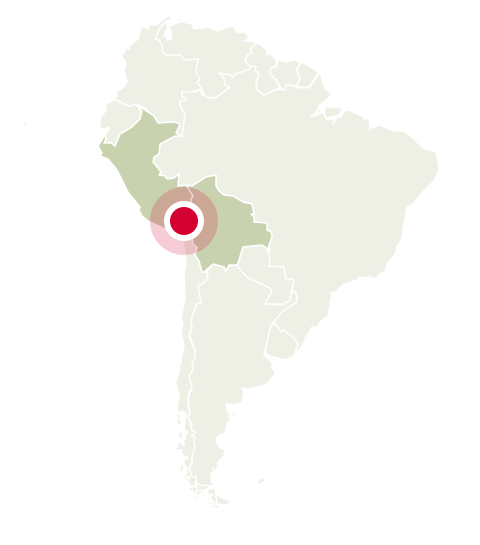
Where it is
In Peru and BoliviaBoat trips to the islands of Lake Titicaca: the Uros reed islands, Taquile and Amantani from Puno, and Isla del Sol from Copacabana, with sunny high-altitude days on the lake.
Combine it with
Places that travel publishers pair with Lake Titicaca. The dots mark the months when both are in shoulder season.
Fills up: Festividad de la Virgen de la Candelaria (Puno)
Peak season
February
About 69% of the busiest month’s visitors
Days 16°C, nights 6°CDays 61°F, nights 43°F
Rain: 145 mmRain: 5.7 in
Fills up: Carnival (Juliaca and Puno)
For the Candelaria: Puno's dance festival, January 30 to February 9, 2027, in the rainy season; book months ahead.
Low season
March
About 58% of the busiest month’s visitors
Days 16°C, nights 6°CDays 61°F, nights 43°F
Rain: 116 mmRain: 4.6 in
Fills up: Easter week (Semana Santa) in Copacabana and Puno
For the Easter pilgrimage to Copacabana: March 25 to 28, 2027, as the rains ease.
Shoulder season
Includes our pick
April to August
About 51 to 89% of the busiest month’s visitors
Days 15 to 16°C, nights −1 to 4°CDays 59 to 61°F, nights 30 to 39°F
Rain: 3 to 51 mm a monthRain: 0.1 to 2.0 in a month
Fills up: Virgen de Copacabana and Bolivian Independence (Copacabana)
For dry weather before the July surge: May, though in 2019 it was busier than July.
For the heart of the dry season: July to September, the busiest months, with freezing nights.
Peak season
September
The busiest month of the year
Days 17°C, nights 2°CDays 63°F, nights 36°F
Rain: 24 mmRain: 0.9 in
For the heart of the dry season: July to September, the busiest months, with freezing nights.
Shoulder season
Includes our pick
October to December
About 74 to 82% of the busiest month’s visitors
Days 17 to 18°C, nights 4 to 6°CDays 63 to 64°F, nights 39 to 43°F
Rain: 40 to 88 mm a monthRain: 1.6 to 3.4 in a month
Fills up: Foundation of Puno
Lake Titicaca visitor numbers
As of November 21, 2026, the latest figures we have for Lake Titicaca run through August 2026.
MeasuredCounted in parts
Also: Visits to the Uros Islands from January to August 2026 were 81.5% higher than in the same months of 2025.
We have not found a published visitor count for Lake Titicaca; Peru's tourism ministry reported the growth at the Uros Islands without giving a count. Next update: January 2027.
Visitors are charged several community fees while walking the island (one traveler paid 10, 15 and 5 bolivianos); no cards or ATMs on the islands.
Book ahead (4)
Candelaria accommodation
Travelers advise: months ahead
Journey Latin America advises booking months ahead for the Candelaria in early February.
Puno hotels and island homestays in July and August
Travelers advise: early
Puno hotels and island homestays fill quickly in July and August.
Copacabana and Isla del Sol beds
Travelers advise: ahead for weekends and holidays
Copacabana accommodation fills up very quickly; Yumani and Challapampa have limited beds, so book ahead for weekends and holidays.
Candelaria dance-contest tickets
Travelers advise: line up on the day
Tickets at 20 to 50 soles; in 2024 hundreds lined up from 3 a.m. 2027 festival January 30 to February 9 (Federación Regional de Folklore y Cultura de Puno).
Closures (1)
Northern Isla del Sol (Challapampa, Chincana ruins)
Closed to tourists for several years after a dispute between northern and southern communities; two blogs say it has reopened (about 80% of the island), while a 2026 guide says access has been intermittently restricted and to ask operators the day before which sections are open. Not a seasonal closure; we have not confirmed its current status.
Rules, fees and closures can change. Check the official site before you go:
The seasons come from official monthly visitor counts. In all, 34 sources back the seasons, dates and rules.
How we pick the months
Our pick is usually the months just outside the peak: the weather is good, there are fewer people and prices are often lower. Missing the biggest crowds and the harshest weather makes for a better trip. When the reason to go happens only at the peak, the pick follows it. The seasons come from comparing official visitor counts, where they exist, weather records and many guides, news reports and traveler accounts, and they follow where those sources agree.
Checked November 2026. Visitor numbers are checked every quarter; next update January 2027.
Weather: station normals as published in Wikipedia climate tables (originally from national weather services); ERA5 reanalysis from the Copernicus Climate Change Service via Open-Meteo (CC BY 4.0).
Spotted something out of date?
Prices, rules and dates change. Tell us and we’ll check it against the source.