Rain290 mm in April, 12 mm in October11.4 inches in April, 0.5 inches in October
Peak seasonShoulder seasonLow season
We have not found monthly visitor counts for Fernando de Noronha, so the bars show the season, not a count. A full drop is 400 mm of rain in a month, on every page.A full drop is 15.7 inches of rain in a month, on every page.
Fernando de Noronha in January
Peak season
30° / 25°86° / 77°day and night, °C°F
63 mm2.5 inof rain
Sunrise
6:10 am
Sunset
6:30 pm
Daylight
12 h 20 min
Mid-month times for a level horizon. Mountains hide the sun for longer.
Summer school holidays. Réveillon fills lodging. Mostly dry; surf season runs December to March.
Feb 6 to 9Carnival. Carnival holiday (Monday and Tuesday February 8 and 9, 2027, per ANBIMA) with the weekend before. 96.77% hotel occupancy at Carnival 2026 (Empetur via Panrotas).
Mar 26 to 28Easter week (Semana Santa). National long weekend: Good Friday March 26, 2027 (ANBIMA), Easter Sunday March 28. Effect on the island not sourced.
Dec 31 to Jan 1Réveillon (New Year's). Three days of parties organized by the island administration around New Year's Eve (2025/26 edition); exact 2027/28 days not announced. The 2026/27 turn is December 31, 2026 to January 1, 2027. Lodging practically 100%, according to the island administration1; 94.67% hotel occupancy, an Empetur figure reported by Panrotas8, Réveillon 2025/26.
Not announcedSummer school vacations. Brazilian summer school holidays from late December through January and into February. January hotel occupancy 80.8% in 2025 (ABIH-PE via Panrotas).
Not announcedJuly school vacations. Mid-year school holidays; the island gets busier and prices rise.
Not announcedRefeno (Recife to Fernando de Noronha sailing regatta). About 94 boats and 700 sailors cross from Recife; free party at Porto de Santo Antônio and awards on the island. 2026 edition: start September 19, party September 21, awards September 23.
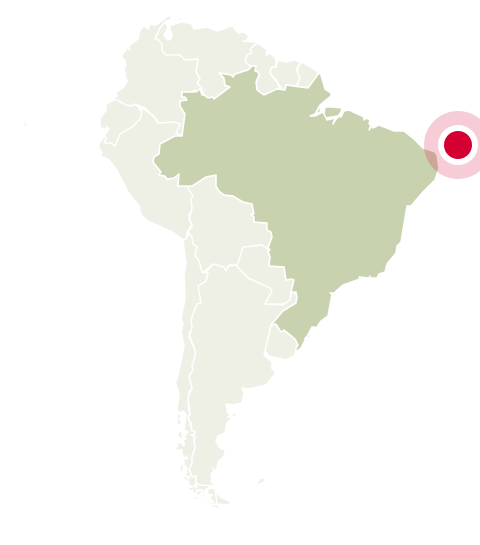
Where it is
In BrazilThe marine national park's beaches and bays, such as Baía do Sancho, and snorkeling and diving in clear, warm water.
Combine it with
Places that travel publishers pair with Fernando de Noronha. The dots mark the months when both are in shoulder season.
We have not found monthly visitor counts for Fernando de Noronha, so these seasons are an estimate: peak season is the months that sources name as peak or that fall in school holidays and major events.
Peak season
December to February
Days 30°C, nights 25°CDays 86°F, nights 77°F
Rain: 18 to 111 mm a monthRain: 0.7 to 4.4 in a month
Fills up: Réveillon (New Year's); Carnival
For surfing: December to March, when swells reach the island.
For Réveillon: three days of parties, with lodging near 100% full.
Shoulder season
March
Days 30°C, nights 25°CDays 86°F, nights 77°F
Rain: 264 mmRain: 10.4 in
Fills up: Easter week (Semana Santa)
For surfing: December to March, when swells reach the island.
Low season
April to June
Days 29 to 30°C, nights 24°CDays 84 to 86°F, nights 75°F
Rain: 190 to 290 mm a monthRain: 7.5 to 11.4 in a month
For lower prices: April to June, the rainy low season, about 30% cheaper.
Shoulder season
Includes our pick
July to November
Days 28 to 30°C, nights 24 to 25°CDays 82 to 86°F, nights 75 to 77°F
Rain: 12 to 122 mm a monthRain: 0.5 to 4.8 in a month
For fewer people: November, dry and sunny, which travelers call quieter.
Fernando de Noronha visitor numbers
As of November 21, 2026, the latest figures we have for Fernando de Noronha run through January 2026.
MeasuredOne total a year
2025
139,901
6.4% more than the 131,503 of 2024, and above the yearly cap of 132,000.
Fernando de Noronha averages. Rain is the monthly total.
Know before you go
As of November 21, 2026.
Rules and fees (6)
Visitor limit: 11,000 a month and 132,000 a year
Set by an agreement between the federal government (ICMBio) and Pernambuco approved by the Supreme Court (STF). Exceeded: 131,503 park visitors in 2024 and 139,901 in 2025; monthly limit passed in six (ICMBio) or eight (CBN Recife) months of 2024. In August 2026 Pernambuco asked ANAC to fit flights to the monthly limit; no decision reported.
Flight capacity in 2026: 34 weekly frequencies, 18,744 seats a month
Azul 18, Gol 11, Latam 5 weekly flights; ANAC estimates about 10,647 tourists a month (as of August 2, 2026).
Environmental Preservation Tax (TPA): R$ 105.79 per day in 2026
Up 4.4% from R$ 101.33 on January 1, 2026; adjusted yearly. The 2027 value was not found.
Marine National Park ticket: R$ 393 for foreigners, R$ 196.50 for Brazilians from November 1, 2026
Up 2.34% (IPCA) from R$ 384 and R$ 192, announced by ICMBio; valid 10 days. The park FAQ page4 still shows R$ 373 and R$ 186.50.
Certified guide required on four trails
Capim-Açu, Pontinha-Caieira, Atalaia-Pontinha-Caieira and Morro São José (swimming option), according to the park's undated FAQ, whose prices are out of date; we have not confirmed the list for 2026-27.
Natural pools: life jacket, mask and snorkel mandatory
No touching the bottom; visits follow the tide, at a time that changes daily; each pool has set daily places. Undated FAQ, not confirmed for 2026/2027.
Book ahead (3)
Trails needing prior booking: Capim-Açu, Abreu, Atalaia, Pontinha-Caieira, Atalaia-Pontinha-Caieira, Morro São José
Travelers advise: In person at the Visitor Center, up to six days ahead
No advance window or daily numbers given on the undated FAQ page; not confirmed for 2026/2027. Booked in person by the visitor, with the park ticket, at most six days ahead; not online (Mercado & Eventos).
TPA payment
Travelers advise: Online before the trip or on arrival
Paid on the state district site; foreign cards at the airport counter; extra days paid on departure.
July activities
Travelers advise: In advance
A traveler site advises booking July activities ahead because the island gets busier.
We have not found monthly visitor counts for Fernando de Noronha, so these seasons are an estimate from guides, news reports and traveler accounts. In all, 32 sources back the seasons, dates and rules.
How we pick the months
Our pick is usually the months just outside the peak: the weather is good, there are fewer people and prices are often lower. Missing the biggest crowds and the harshest weather makes for a better trip. When the reason to go happens only at the peak, the pick follows it. The seasons come from comparing official visitor counts, where they exist, weather records and many guides, news reports and traveler accounts, and they follow where those sources agree.
Checked November 2026. Visitor numbers are checked every quarter; next update January 2027.
Weather: station normals as published in Wikipedia climate tables (originally from national weather services); ERA5 reanalysis from the Copernicus Climate Change Service via Open-Meteo (CC BY 4.0).
Spotted something out of date?
Prices, rules and dates change. Tell us and we’ll check it against the source.