Rain318 mm in January, 73 mm in August12.5 inches in January, 2.9 inches in August
Peak seasonShoulder seasonLow season
We have not found monthly visitor counts for Madidi & Rurrenabaque, so the bars show the season, not a count. A full drop is 400 mm of rain in a month, on every page.A full drop is 15.7 inches of rain in a month, on every page.
Madidi & Rurrenabaque in January
Low season
31° / 22°89° / 71°day and night, °C°F
318 mm12.5 inof rain
15 dayswith rain
Sunrise
6:10 am
Sunset
7:05 pm
Daylight
12 h 55 min
Mid-month times for a level horizon. Mountains hide the sun for longer.
Rainy season; pampas flood and wildlife spreads out. Flights and roads are often disrupted, so allow buffer days.
Mid-month times for a level horizon. Mountains hide the sun for longer.
Dry and cooler; surazo cold fronts can drop temperatures to about 12°C. One operator advises booking ahead.Dry and cooler; surazo cold fronts can drop temperatures to about 54°F. One operator advises booking ahead.
Feb 2Fiesta de Rurrenabaque (Virgen de la Candelaria). Town founding feast: Mass, Candelaria procession, horse races, cockfights and canoe races. Only Bolivia Travel Site10 describes the fiesta; Universidad Autónoma del Beni José Ballivián9 gives only the founding date (February 2, 1844) under the Virgen de la Candelaria.
May 1 to Oct 31Dry-season high season (temporada alta). Most tour groups come in the dry season; local estimate of the high season. Restaurant occupancy estimated at 65 to 85%9; estimate, not measured.
Sep 4 to 5Feria Artesanal. Craft fair on the first weekend of September with music, dance and conservation events.
Nov 18Fiesta del Beni. Beni department day, celebrated across the province.
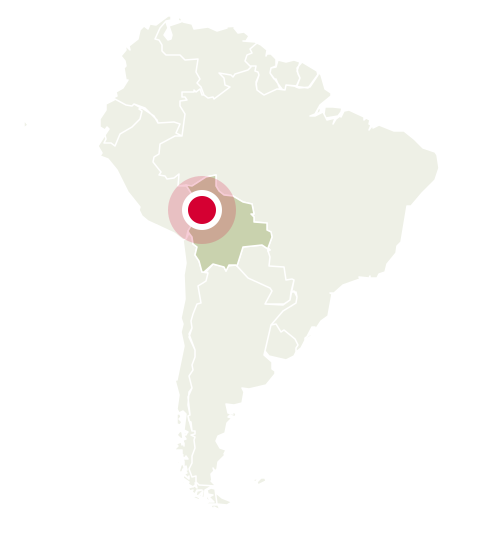
Where it is
In BoliviaWildlife on a boat-based pampas tour of the Río Yacuma wetlands from Rurrenabaque (caimans, capybaras, pink river dolphins, monkeys, birds), often paired with a jungle-lodge stay in Madidi National Park.
Combine it with
Places that travel publishers pair with Madidi & Rurrenabaque. The dots mark the months when both are in shoulder season.
We have not found monthly visitor counts for Madidi & Rurrenabaque, so these seasons are an estimate: peak season is the months that sources name as peak or that fall in school holidays and major events.
Low season
December to March
Days 31 to 32°C, nights 21 to 22°CDays 88 to 90°F, nights 70 to 72°F
Rain: 241 to 318 mm a monthRain: 9.5 to 12.5 in a month
Closed: Rainy-season road and flight disruption
Fills up: Fiesta de Rurrenabaque (Virgen de la Candelaria)
December to March the savannah floods and is bird-rich, with mosquitoes, mud and flight delays11, 25.
Shoulder season
April
Days 31°C, nights 20°CDays 88°F, nights 68°F
Rain: 158 mmRain: 6.2 in
Peak season
Includes our pick
May to October
Days 28 to 33°C, nights 16 to 20°CDays 82 to 91°F, nights 61 to 68°F
Rain: 73 to 135 mm a monthRain: 2.9 to 5.3 in a month
Fills up: Dry-season high season (temporada alta); Feria Artesanal
May, June and October are still dry: less mud and fewer mosquitoes on jungle trails20, 25.
Shoulder season
November
Days 32°C, nights 21°CDays 90°F, nights 70°F
Rain: 193 mmRain: 7.6 in
Fills up: Fiesta del Beni
Madidi & Rurrenabaque visitor numbers
As of November 21, 2026, we have not found a 2025 or 2026 visitor count for Madidi. Bolivia as a whole had 1,145,165 foreign visitors in 2025, according to the national statistics institute (INE).
Bs 150 per person, paid in cash, not included in tour prices2, 8, 13, 14, 23. No 2026 or 2027 official tariff found.
Madidi National Park entrance fee
Bs 125 per person, usually not included by operators2, 8, 25. No 2026 or 2027 official tariff found; SERNAP listed optimizing the SISCO tariff as 2025 work1, so the fee may change. An operator listing (Nomades) gives Bs 200 per person, paid in cash and not included in tour prices; we have not found a SERNAP fee table.
Minimum pampas tour price
One 2018 blog says a minimum of 1200 Bs per person is set by law; not confirmed by an official source.
Book ahead (4)
Buffer time for La Paz flights
Travelers advise: Allow a day or two
Flights are often delayed or canceled by weather, especially in the rainy season22, 23, 27, 28.
Book ahead in April to June
One operator says April, May and June bring the most tourists and recommends booking ahead10.
Booking tours locally
Booking in Rurrenabaque is cheaper than booking in La Paz in advance20.
Cash for fees and tours
Park fees are paid in cash12, 14; blogs say there is no reliable ATM in town20, 21.
Closures (3)
Rainy-season road and flight disruption
December to March, every year
No closure of the parks or tours was found. In the rains several road stretches can become impassable9, floods are common and road and air travel less reliable10; flights are more likely canceled December to March22, 25 and pampas jeep transfers run later14.
Beni River flood emergencies
February and March
Rurrenabaque and San Buenaventura were declared in disaster in March 20256; river red alerts were issued in 2014, 2019 and 20249. Not every year.
Late dry-season fires and smoke
September to November
Land-clearing fire smoke obscures skies toward the end of the dry season3; in 2023 fires burned near Rurrenabaque for more than 40 days into November15.
Rules, fees and closures can change. Check the official site before you go:
We have not found monthly visitor counts for Madidi & Rurrenabaque, so these seasons are an estimate from guides, news reports and traveler accounts. In all, 32 sources back the seasons, dates and rules.
How we pick the months
Our pick is usually the months just outside the peak: the weather is good, there are fewer people and prices are often lower. Missing the biggest crowds and the harshest weather makes for a better trip. When the reason to go happens only at the peak, the pick follows it. The seasons come from comparing official visitor counts, where they exist, weather records and many guides, news reports and traveler accounts, and they follow where those sources agree.
Checked November 2026. Visitor numbers are checked every quarter; next update January 2027.
Weather: station normals as published in Wikipedia climate tables (originally from national weather services); ERA5 reanalysis from the Copernicus Climate Change Service via Open-Meteo (CC BY 4.0).
Spotted something out of date?
Prices, rules and dates change. Tell us and we’ll check it against the source.